The appetite for cross-border deals has rocketed by 18% during the past 12 months. This is the key finding from our latest research that looks at attitudes to mergers and acquisitions (M&A) among business leaders worldwide.
In the second of our Future of Europe series, we look at three aspects of the sovereign debt crisis: the stagnation of the region’s economies, closer integration and the future expansion of Europe.
Scaling a tech business is like walking a burning tightrope. The faster you go, the more you risk falling off. But go too slowly and the rope will burn through.
Business-minded technologists have always planned for global business empires. It used to take decades before they could grow globally. Today, it can be more or less instantaneous – creating a new set of opportunities and threats.
For tech companies, the regulatory environment is tougher now than ever before. To protect national interests, governments are using compliance to restrict companies that could potentially disrupt established industries which can creating a knock on effect for tech companies. Rapidly expanding companies also face a wider range of individual regulations as they expand into new territories, be it employment law, taxation, product safety or licensing.
As global attitudes towards tax change, tech companies need to future-proof their tax practices to stand up to enhanced scrutiny. The way in which companies markets and sells its services can also have tax implications. Therefore, one thing is clear – tax matters, and ambitious tech companies need to develop a tax strategy that can keep pace with their growth aspirations.
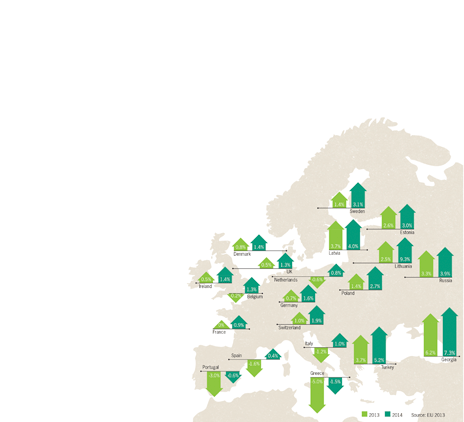
Last week, we released the results of the Grant Thornton Global Dynamism Index (GDI) 2013. This is the second year we have released these results. We are seeing the beginning of trends in the data but there was also some interesting movement up and down the rankings.
Stefano Salvadeo was interviewed on Focus Economia di Radio 24 recently to discuss some positive indicators regarding M&A activity in Italy.
Thinking outside the Big Blue box. Scott Barnes responds to UK Competition Commission proposals.
These are the results of the Grant Thornton Global Dynamism Index (GDI) 2013, an annual research project designed by the Economist Intelligence Unit, which ranks the development of the business growth environments of 60 of the world's largest economies over the past 12 months.
A lot has been written about auditor rotation over recent months, but in August, India became the latest major economy to actually enforce mandatory rotation. This is big news. And not just for us accountants.
Businesses in the hospitality & tourism industry are the most bullish globally on the outlook for both revenues and profits. That’s according to the Q2 International Business Report (IBR[1]) results, providing further evidence of strong performance in the industry.
Reviewing the Q2 International Business Report (IBR[1]) results, I was pleased to see some good news for construction & real estate companies: Profitability expectations around the world are up. However, my optimism is tempered somewhat by recent news from China and it will be interesting to see how businesses react in Q3.
The issue of transfer pricing has hit the headlines in the UK and the US over recent weeks due to the relatively low level of corporation tax multinationals such as Amazon, Apple, Google and Starbucks.
The brightening outlook for Spain. Rising exports amongst reasons to be optimistic